You are not logged in |





ICPC Europe 2026
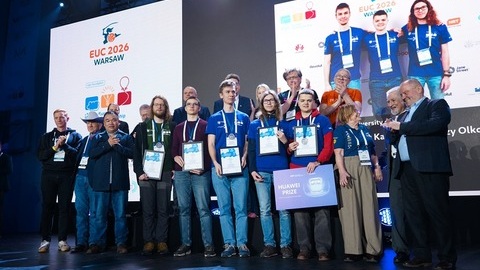
The ICPC Europe 2026 took place on the weekend of February 7-8, co-organized by our Faculty. The University of Warsaw team, composed of Jan Gwiazda, Stanisław Karpiejczyk, and Jerzy Olkowski, won the silver medal (7th place). Delft University of Technology was crowned the European Academic Champion.
We extend our heartfelt congratulations to the laureates and our warmest gratitude to the ICPC Foundation for their trust and help!
On Sunday, February 8, 2026, the 3rd European Collegiate Programming Championship took place at the Faculty of Management at the University of Warsaw. This competition is part of the global International Collegiate Programming Contest (ICPC), which brings together three-person teams from the world's top universities to compete for the global finals.
This year's 50th ICPC World Finals will take place on November 15–20, 2026 in Dubai (icpc.global). During the competition in Warsaw (ICPC EUC 2026, euc.icpc.global), teams competed not only for the prestigious title of European Academic Champion 2026 but also for qualification for the global finals.
Fifty-three teams from 53 universities, representing leading European academic centers educating computer scientists, traveled to Warsaw. The teams earned the right to compete in the European Championships in four regional ICPC competitions: Southeast (SEERC), Southwest (SWERC), Northwest (NWERC), and Central Europe (CERC). The top two universities from each region gained direct qualification to the ICPC World Finals in Dubai. In Warsaw, another eight top-ranked universities earned the participation in the finals.
In the ICPC EUC 2026 Championships, teams had to solve 11 algorithmic problems during a five-hour session. The international panel of judges prepared an exceptionally difficult set of problems, posing a serious challenge even for the most experienced enthusiasts of algorithmic problem-solving. Of the 11 problems, eight were ultimately solved. The European champions solved five problems—the same number as the next ten teams—and the final ranking was determined by the time they completed them. Four gold medals, four silver medals, and four bronze medals were awarded.
The team representing Delft University of Technology (Netherlands) won gold and is the European Academic Champion in Collegiate Programming.
The next three places, also with gold medals, were taken by teams representing:
2. Alexandru Ioan Cuza University of Iași
3. The Open University of Israel
4. Universiteit Utrecht
The next four places, each with silver medals, were taken by:
5. Hasso Plattner Institute
6. ETH Zürich
7. University of Warsaw (Jan Gwiazda, Jerzy Olkowski, Stanisław Karpiejczyk)
8. University of Belgrade
The bronze medalists were:
9. University of Cambridge
10. Middle East Technical University
11. Charles University
12. Karlsruhe Institute of Technology (with four solved problems)
It is worth noting that outstanding former competitors representing three companies supporting the organization of the championship: Google, HRT, and Huawei, also participated in the competition. The Huawei team was the only one to solve 6 problems.
Recognizing the excellent organization of the competition in Warsaw and the very high level of expertise, the director of the ICPC global competition, Prof. William Poucher, decided to increase the number of teams advancing from Warsaw to the global finals to 10.
The full list of universities that will represent Europe in the 50th World Academic Collegiate Programming Championship Finals in Dubai includes:
Alexandru Ioan Cuza University of Iași, Charles University, Delft University of Technology, Eötvös Loránd University, ETH Zürich, Hasso Plattner Institute, Karlsruhe Institute of Technology, Kharkiv National University of Radio Electronics, Middle East Technical University, Tel Aviv University, The Open University of Israel, Universiteit Utrecht, University of Belgrade, University of Cambridge, University of Oxford, University of Vienna, University of Warsaw, and University of Wrocław.
The Warsaw Championships were a resounding organizational success for the University of Warsaw, particularly the Faculty of Mathematics, Informatics, and Mechanics, the Faculty of Management, and the Foundation for Computer Science Development. The ICPC Foundation, globally responsible for the ICPC competition, also provided invaluable support.
In the 1970s, the eminent American computer scientist Donald Knuth published the three-volume work "The Art of Programming". The championship participants undoubtedly deserve to be called true artists of algorithmic thinking. Their artistic talents harmonized particularly well with the artistic performances during the opening and closing ceremonies by Piotr Pawlak—an outstanding Polish pianist, computer scientist, and mathematician; the Choir of the Faculty of Mathematics, Informatics, and Mechanics of the University of Warsaw; and the Dance Theatre of the University of Warsaw "Warszawianka."
Krzysztof Diks